
Background
Security measures at data centers and critical infrastructure facilities have become increasingly stringent year by year. While the primary focus was traditionally on cybersecurity for networks and systems, the importance of physical security has grown rapidly in recent years in response to risks such as unauthorized entry and insider threats. In particular, access control systems are being reevaluated as a fundamental component of security strategies.
Currently, widely used authentication methods for access control include ID card authentication, PIN-based authentication, and biometric authentication such as facial recognition, vein recognition, and fingerprint recognition. While these methods can provide a certain level of security on their own, there is growing demand for multi-factor authentication (MFA) to meet increasingly sophisticated security requirements. For example, combining multiple factors, such as an access card and biometric authentication, can significantly reduce the risk of unauthorized use.

Table of Contents
Challenges
However, the advancement of security measures has also brought new challenges. One of the major concerns is cost. Biometric authentication systems typically require substantial initial investment, as well as ongoing operational and maintenance expenses. In addition, processes such as biometric enrollment and updates can be time-consuming, creating additional burdens for both users and administrators.
The handling of personal information is another significant challenge. Biometric data is highly sensitive information that requires strict management. When such data is stored in external systems, organizations must implement robust measures to prevent data breaches and unauthorized access. Furthermore, traditional risks—such as PIN disclosure and unauthorized use resulting from lost or stolen cards—still remain.
As a result, organizations often face a structural dilemma: the stronger the security measures become, the greater the increase in costs, operational workload, and management complexity. This challenge is particularly evident when multiple systems must be integrated to achieve multi-factor authentication, as each component requires separate administration and coordination, making overall optimization difficult.
What EnerCera Can Offer
An effective solution to these challenges is the Battery-Powered Fingerprint Authentication Card.
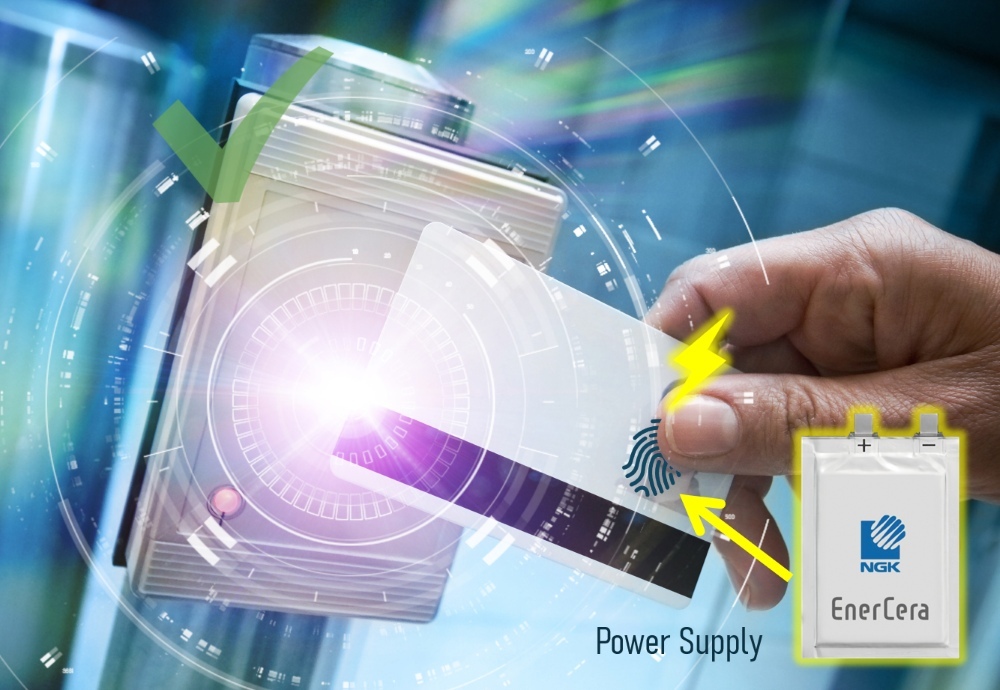
This solution incorporates fingerprint authentication functionality directly into the card itself. In addition, the card contains an internal battery, allowing authentication processing to be performed independently without relying on power supplied by a reader. This is one of its key differentiators.
With conventional biometric authentication systems, user verification must be performed at an entrance gate or dedicated authentication terminal. In contrast, this solution enables users to authenticate themselves directly on the card using their fingerprint. Only when authentication is successfully completed does the card become activated. The user can then simply present the card to a standard reader and gain access in the same way as a conventional ID card.
Because possession of the card alone is insufficient for authentication, the risk of unauthorized use by a third party is significantly reduced, even if the card is lost or stolen. Furthermore, since authentication takes place in advance, users do not need to perform authentication procedures at the gate itself, enabling smooth passage even in high-traffic environments.
Another major advantage is the ability to achieve multi-factor authentication using a single device. Unlike conventional approaches that require multiple devices or integrated systems, this solution provides a simple architecture while maintaining a high level of security. In addition, fingerprint data is stored exclusively within the card and does not need to be saved on external servers, significantly reducing the risk of personal information leakage.
Furthermore, because biometric enrollment on the facility-side equipment is unnecessary, operational workload can be reduced considerably. Tasks associated with adding, removing, or updating users become much simpler, helping to minimize administrative burden. Since authentication is completed entirely within the card, the solution can also operate in offline environments without dependence on a network—an especially valuable feature for critical facilities.

Conclusion
Looking ahead, access control systems must continue to evolve to become more secure and simpler to operate. Organizations should carefully evaluate the challenges and inefficiencies of their current systems and consider new approaches that align with their specific security requirements. For facilities seeking an efficient and effective way to implement multi-factor authentication, the Battery-Powered Fingerprint Authentication Card represents a highly compelling option.